LU-KV: KV Cache Optimization Based on Long-term Utility
💡 TL;DR: When large language models process extremely long texts and run out of memory, how do we cope? LU-KV predicts the “future value of each memory fragment” to decide what to keep and what to discard, enabling models to maintain strong comprehension under tighter memory budgets.
📚 Background: What Is KV Cache?
How Do Large Models “Read” Long Documents?
When you ask a large model to analyze a lengthy article, it needs to understand each word while remembering everything it has read before. This “memory” process relies on the attention mechanism:
Current token ←[attends to]→ All previous tokens
To accelerate computation, the model caches the “Keys” and “Values” of previous tokens — this is called the KV Cache.
Why Do We Need Eviction?
| Scenario | Context Length | KV Cache Memory Usage |
|---|---|---|
| Casual conversation | ~1K tokens | ~0.5 GB |
| Reading a paper | ~32K tokens | ~16 GB |
| Legal contract analysis | ~128K tokens | ~64 GB ⚠️ |
When memory runs out, we must discard part of the cache — this is KV Cache Eviction. The central question: What should we discard to minimize performance loss?
📜 A Brief History of KV Cache Eviction
🔹 First Generation: Uniform Compression (2023)
Core Idea: Treat all positions equally and discard at a fixed ratio.
\[\text{Retention rate} = r \quad \Rightarrow \quad \text{retain } \lfloor r \times N \rfloor \text{ tokens per position}\]Representative Works: StreamLLM, H2O
Strengths: Simple to implement, low computational overhead
Limitations: Ignores importance differences across positions and attention heads; critical information may be accidentally discarded
🔹 Second Generation: Structure-Prior-Driven (2024)
Core Idea: Use structural patterns of text and models to guide eviction.
\[\text{Retention probability} \propto f(\text{position}, \text{layer depth}, \text{attention pattern})\]| Method | Structural Prior | Intuition |
|---|---|---|
| PyramidKV | Shallower layers carry more dispersed information | Like a pyramid: wide base (keep more), narrow top (keep less) |
| HeadKV | Different attention heads serve different roles | Like a team with division of labor: some focus on details, others on the big picture — budget allocated accordingly |
| CAKE | Spatially dispersed tokens are more important | Like map landmarks: scattered key points are more worth keeping than clustered ordinary ones |
Progress: Domain knowledge improves compression efficiency
Limitations: Fixed rules, hard to adapt to new tasks or distributional shifts
🔹 Third Generation: Dynamic Adaptation (2025–2026)
Core Idea: Dynamically adjust based on real-time statistical signals.
\[b_{\ell,h} = g\big(\text{AttentionEntropy}_{\ell,h}, \text{TaskContext}\big)\]where \(b_{\ell,h}\) denotes the retention budget for the \(h\)-th head in layer \(\ell\).
Representative Work: Ada-KV
Strengths: Task-adaptive, online adjustment
Key Limitation: Still assumes “high current attention score = high long-term importance”
🎯 The Core Problem: This assumption does not always hold! High scores in some attention heads may be merely “transient noise,” while low-scoring heads may capture critical long-range dependencies (e.g., discourse topics, causal chains).
🔹 Fourth Generation: LU-KV — Global Optimization via Long-term Marginal Utility (2026)
Core Breakthrough: Elevates eviction decisions from “instantaneous scoring” to “long-term value prediction”.
\[\boxed{ \max_{\{b_{\ell,h}\}} \sum_{\ell=1}^{L}\sum_{h=1}^{H} \underbrace{\mathbb{E}\big[\text{Long-horizon Utility} \mid b_{\ell,h}\big]}_{\text{Expected long-term semantic information retention}} \quad \text{s.t.} \quad \sum_{\ell,h} b_{\ell,h} = B_{\text{total}} }\]Intuition:
Instead of asking “How important is this token right now?”, we ask “If we keep it, how much will it help future reasoning?”
🧠 LU-KV: Method Details
Step 1: Formulate KV Cache Eviction as a Global Combinatorial Optimization Problem
Allocate a fixed memory budget \(B_{\text{total}}\) across \(L \times H\) attention heads, where each head retains \(b_{\ell,h}\) tokens:
\[\begin{aligned} \min_{\{b_{\ell,h}\}} \quad & \sum_{\ell=1}^{L}\sum_{h=1}^{H} \mathcal{L}_{\ell,h}(b_{\ell,h}) \\ \text{s.t.} \quad & \sum_{\ell=1}^{L}\sum_{h=1}^{H} b_{\ell,h} = B_{\text{total}} \\ & b_{\ell,h} \in \mathbb{Z}_{\ge 0} \end{aligned}\]Key Challenge: This is a high-dimensional discrete combinatorial optimization problem — direct solving is computationally intractable.
Step 2: Efficient Solution via Mathematical Techniques
To solve this non-convex optimization problem, LU-KV employs convex hull relaxation + greedy rounding:
- Convex Hull Relaxation: Converts the discrete problem into continuous optimization to quickly find a “near-optimal” allocation ratio
- Greedy Rounding: Sequentially allocates integer budgets in descending order of marginal utility
Result: Dramatically faster solving speed with near-optimal solution quality compared to dynamic programming.
Step 3: Offline Learning + Zero Online Overhead
In practice, future decoding information is unavailable during the current decoding step. Fortunately, the information fidelity of each attention head exhibits a degree of stability across tasks. As shown in the figure below, the locally optimal compression rates are similar across different tasks!
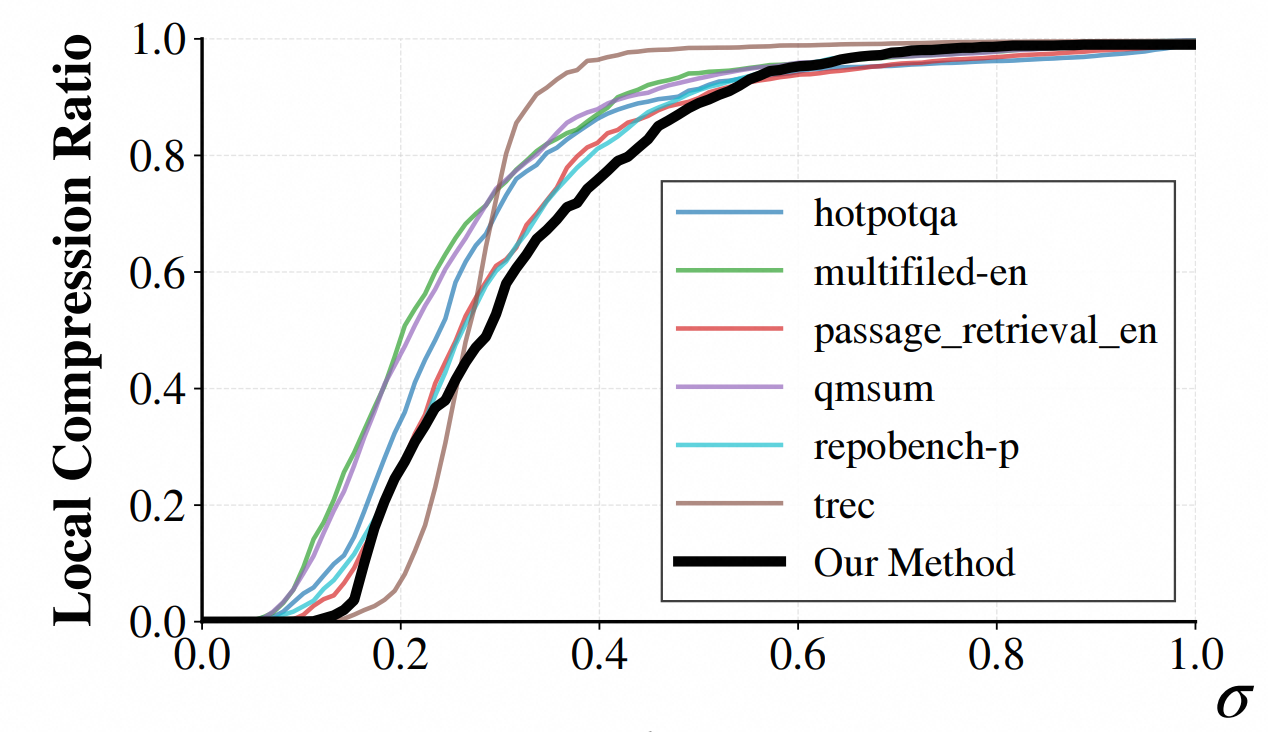
Therefore, LU-KV adopts a “learn once, use many times” strategy:
🔧 Offline Phase (run once before deployment):
- Analyze the “compression rate vs. utility” curve for each attention head on representative data
- Build a lookup table \(\Phi\): given target compression rate \(\sigma\), output the optimal retention ratio \(\{r_{\ell,h}\}\) for each head
⚡ Online Phase (per inference, zero optimization overhead): \(\begin{aligned} 1.\ & \text{Lookup:} \quad \{r_{\ell,h}\} \leftarrow \Phi(\sigma_{\text{target}}) \\ 2.\ & \text{Budgeting:} \quad b_{\ell,h} = \lfloor (1 - r_{\ell,h}) \times T \rfloor \\ 3.\ & \text{Eviction:} \quad \text{Each head independently retains top-}b_{\ell,h}\text{ tokens} \end{aligned}\)
✅ Advantages:
- Metric-agnostic: Compatible with any instantaneous scoring method (SnapKV, H2O, etc.)
- Zero online overhead: Adds only <1ms table lookup time
- Plug-and-play: No modification to model architecture or training pipeline required
🎯 Summary
The core value of LU-KV can be summarized as:
| Dimension | Key Contribution | Practical Impact |
|---|---|---|
| 🔬 Theoretical Innovation | First to model KV Cache eviction as a “long-term marginal utility maximization” combinatorial optimization problem | Provides a provable theoretical framework for cache management, going beyond heuristic approaches |
| ⚙️ Engineering Practicality | Offline analysis + online lookup table: zero inference overhead + metric-agnostic design | No modification to model or training pipeline; plug-and-play integration with existing systems |
💡 One-line Recap: LU-KV doesn’t “shortsightedly discard low-value cache” — it “retains with greater foresight” — ensuring every byte of a large model’s memory is allocated where it is most likely to generate value.
🔗 Resources
📄 Citation
If you find this work useful, please cite our paper:
@inproceedings{
    tang2026predicting,
    title     = {Predicting Future Utility: Global Combinatorial Optimization
                 for Task-Agnostic {KV} Cache Eviction},
    author    = {Ziyao Tang and Pengkun Jiao and Xinhang Chen and
                 Wei Liu and Shiyong Li and Jingjing Chen},
    booktitle = {Forty-third International Conference on Machine Learning},
    year      = {2026},
    url       = {https://openreview.net/forum?id=FQLxcBsKIb}
}
Enjoy Reading This Article?
Here are some more articles you might like to read next: